How To Write

Guest post of sorts. That will appeal primarily to the small subset of PressingPausers who fancy themselves cycling nerds. Ben Farver is the Founder of Argonaut Cycles, a custom/boutique/ultra bougie bicycle manufacturer based in Bend, OR.

As concise and clear a design philosophy as you’re ever going to read. Ben in Bend for the win.

The Wrong Problem

The industry has been racing toward aerodynamics and stiffness for a decade. Neither one is the most important thing about a bicycle.

Ben Farver, Founder of Argonaut Cycles

Every major bike brand is in a race right now to make the most aerodynamic frame on the market.

I think they’re optimizing for the wrong thing.

That’s not a contrarian position for its own sake. Aerodynamics matter. Weight matters. The gains are real. But the conversation the industry is having about what makes a bicycle better has narrowed to a point where it’s almost entirely about numbers that most riders will never meaningfully feel.

And in that narrowing, the thing that actually determines whether a ride is transcendent or just fast has gotten lost.

Aerodynamic gains only matter if you’re racing. Ride quality matters on every single ride.

Here’s how the industry argument goes. Make the frame slipperier, reduce rolling resistance, optimize the tire interface. Get the rider from point A to point B faster with less effort. That’s the whole conversation.

And I understand it. Going fast on a road bike is one of the closest feelings we get to flying. Thirty miles an hour, two and a half feet above the ground. Faster is better. I’m not arguing otherwise.

But those aerodynamic gains only pay real dividends at the elite level. They matter in a race, where the difference between first and fourth is measured in seconds. They matter when you’re in a peloton, and drafting dynamics actually change what a more slippery frame is worth.

For everyone else, the gains are marginal at best. And most riders aren’t racing. Most riders are out for three hours on a Saturday morning, trying to find what makes cycling worth doing.

That thing has a name. I call it dynamic response.

It’s the feeling of the frame working with you, rather than just under you. The load-and-release quality that makes pedaling feel effortless when it should and explosive when you want it to. The vertical compliance absorbs the road without throwing you off your line. The torsional integrity that holds the bike dead stable at fifty miles an hour on a descent.

These aren’t vague experiential claims. They’re engineering outcomes. Specific, measurable, designable. They just require a different set of questions than the industry currently asks.

The bikes that win the aerodynamic argument all ride the same. That’s not a coincidence. It’s the cost of optimizing for one variable.

The irony is that I’m not ignoring the aerodynamic conversation. The RM4 is in development and will be more aerodynamically efficient than the RM3. Slipperier. Faster. That matters.

But the design intention isn’t to make it faster at the cost of everything else. It’s to make riding faster and more satisfying. To push both ends of the spectrum at the same time.

That’s the argument we get to have that nobody else does. Because we’re not starting from the aerodynamic frame and trying to add ride quality back in. We’re starting from ride quality and building outward.

Most of the industry has it backwards.

The RM3 is like the classic Porsche 911. The RM4 will be the one sitting next to it in the garage that makes you realize how much further the idea could go. The difference is that both are built around how they feel to drive. Not just how quickly they get around a track.

There’s a reason people who get on our bikes for the first time tell me they’re stiffer than the bikes they came from. I know for a fact they’re usually not. The frame they got on isn’t as stiff as their previous bike by any objective measure.

But it has better power transfer. It has that load-and-release quality that people associate with stiffness because it’s the closest sensation they have a word for. What they’re actually feeling is the frame doing its job well.

That’s the problem worth solving.

Not how quickly the frame moves through the air. But how well it moves with the person on it.

The industry will keep improving aerodynamics. Tubes will get more optimized. Drag coefficients will keep dropping. And those bikes will keep winning races.

What they won’t do is give you the feeling that made you fall in love with riding in the first place.

That one is ours to build.

Maybe a better title for this post would’ve been, “How To Think”. And hell yes I want one.

On The Sidewalk Ramp Above Deschutes Parkway

Last night I went for a beautiful sunset run. West Bay, Tugboat Annie’s flyby, and back to Cap Lake for a short out and back. I unplugged and started walking at the base of the sidewalk ramp beside the Fifth Street Bridge. And that’s where our story begins. A story I could use your help processing.

Halfway up the first switchback, just above Deschutes Parkway, a women was lying on a blanket seemingly going through her bedtime routine. All sorts of accessories were spread across her blanket which covered the entire width of the sidewalk. As I approached, she said, “You can go around the other way.” Haha, I thought to myself, I’m not taking the unnecessarily long route tonight.

So your intrepid reporter stepped over and around her with one of my dogs landing smack dab on her blanky. Which set her off a bit. “I’m going to say you raped me.” Unable to process that, I kept walking. And then, “Faggot.” That got me to u-turn and engage. Feel free to deduct points at this point.

What I should’ve said is “Homophobic much?” Instead, I asked a question, “Why don’t you think people should be able to walk on this public sidewalk?” Brown skinned, maybe even indigenous, she said, “Because it’s my land.” To which I said, “Well, thank you for letting me use it tonight.” Close curtains.

Come on, you have to give me back the points you previously deducted for the smoothish ending.

This story is either a run-of-the-mill anecdote or an important case study about class differences, urban life, and how we will or won’t get along. Or something in between, I’m not sure.

The only thing I know for sure is that I don’t know my neighbor’s story. Nothing could explain away what she said, but I’m disinclined to castigate her more generally for being troubled and impoverished since I have no idea how she ended up going to sleep on the sidewalk ramp above Deschutes Parkway.

Oh Oh!

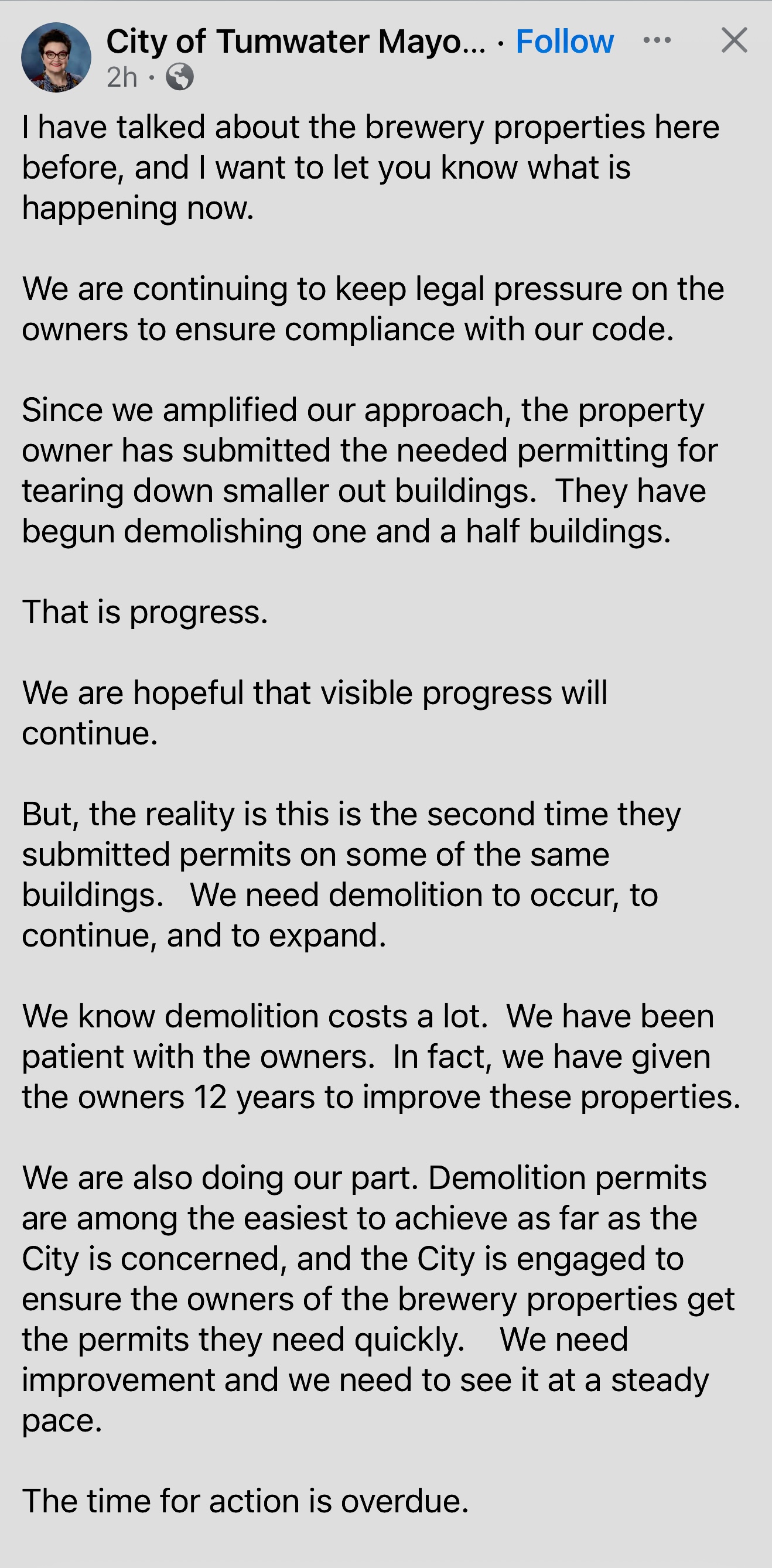
When it comes to Lynn’s estate details, we’re rounding third base and heading home. As the trustee of her estate, this sentence from an “outline of important details of the trust administration process” stopped me cold.

“You are under a duty to exercise the judgment and care that a person of prudence, discretion, and intelligence exercises in managing his or her own affairs.”

If my estate attorney knew me better, she’d lower that bar. Or Washington State more generally. :)

Lean In

You are anxious and want to take a “cognitive behavioral therapy” approach to becoming less anxious. Meaning more practice exposing yourself to anxiety inducing content. Or maybe your life is just way too peaceful and you want/need more drama.

I have just the thing. The “Thurston County Scanner, News, and Weather” Facebook site. Which reveals the seamy underside of ThursCounty. Let’s get down and dirty and embrace the underside. Shall we?

Exhibit A. May 15th. Olympia Police Department are responding to the Olympia Farmer’s Market for a report of a naked man with a beard, dancing on the stage. While coming in the area, law enforcement had eyes on the male and reported that he was now wearing pants.

Of all places to nude bomb, why the bucolic center of our charming community?! My fave part of this report is the phrase “man with a beard” as if there were multiple dancing nudies. Thank you for that helpful detail.

Get’s worser.

Exhibit B. May 16th. Another peaceful day at the Olympia Farmers Market was interrupted when Olympia Police Department responded to reports of a male who had climbed onto the roof of Pithos Gyros and began urinating from the roof. After finishing his business, he continued wandering around the rooftop. The subject is also said to be associated with a second individual inside the market. No word on what inspired the elevated decision-making, but we can confirm the Farmers Market does not currently offer rooftop restroom facilities. It does not sound like he has been located.

So, if you’re like me, and enjoy frequenting the Olympia Farmer’s Market, prepare yourself for more than flowers, fruit and veggies, and snow cones. Sheriff Sanders reply, “I hate it when I find myself on the roof of an unassuming business and nature calls” for the win.

One Way To Start Your Day

From The Olympian.

“At exactly 5 a.m., Kearns looked up at Mount Rainier and then took off for the 14,410-foot summit. . . . Three hours and fifty-three minutes later, he was back with a record.”

Simon Kearns with the new FKT, fastest known time, from the Paradise parking lot to the summit and back.

Kicking and Screaming Into The Future

Charlotte Alter on X writes, “Want to hear a horror story?”

My very sweet husband emailed me a couple dinner options for our anniversary coming up. He listed a couple different restaurant/picnic options and asked which I preferred. I started replying to his email and that’s when I noticed…That Gmail AI had the gall to DRAFT MY ANSWER FOR ME, the audacity to select a restaurant on my behalf.

It picked badly. It picked the restaurant that is most well reviewed. I want to go to the place that is special for us because we’ve had lots of nice memories there.

But the AI wouldn’t know that. Because it isn’t me, it hasn’t been married to my husband for 7 years, and it doesn’t know what we’ve been through recently and why I would want to go to our spot.

Which is why it should stay the fuck out of my email and my marriage.”

“Different restaurant/picnic options”?! The “very sweet husband” for the win.

On Mental Illness

Here’s one especially thought provoking paragraph from Dr. Awais Aftab’s New York Times essay, “We’re Thinking About Mental Health Diagnoses All Wrong”.

The symptoms of mental illness reinforce one another. An important theory in psychiatry, known as network theory, posits that mental health problems emerge from symptoms pushing and pulling on one another in self-reinforcing loops. Being unable to sleep can fuel daytime nervousness; nervousness can drain energy; low energy can lead to social isolation; isolation can worsen depressive rumination; and rumination can make it difficult to sleep. And so on. Symptoms are often triggered by life stressors, but once the symptom arrangement becomes self-sustaining, it continues on long after the stressor has disappeared.”

I liked the essay, but found it a little too abstract for my peabrain. I wish Aftab had illuminated his intriguing insights with examples from his patients’ lives. I assume, maybe incorrectly, that therapists can finesse client-patient privilege by tweaking contexts and names.

Aftab’s readers, unsurprisingly with bigger brains than me, embraced his insights sans examples. Dig this top comment.

Awais Aftab for the win.